Federal courts took in 608,511 new filings during the twelve months ending June 30, 2026. That is a rise of 12.2 percent from the year before, according to filing statistics published by the United States Courts in July 2026. Households drove almost all of that volume, with 581,570 non-business cases. Chapter 7 alone accounted for 382,161 of them.
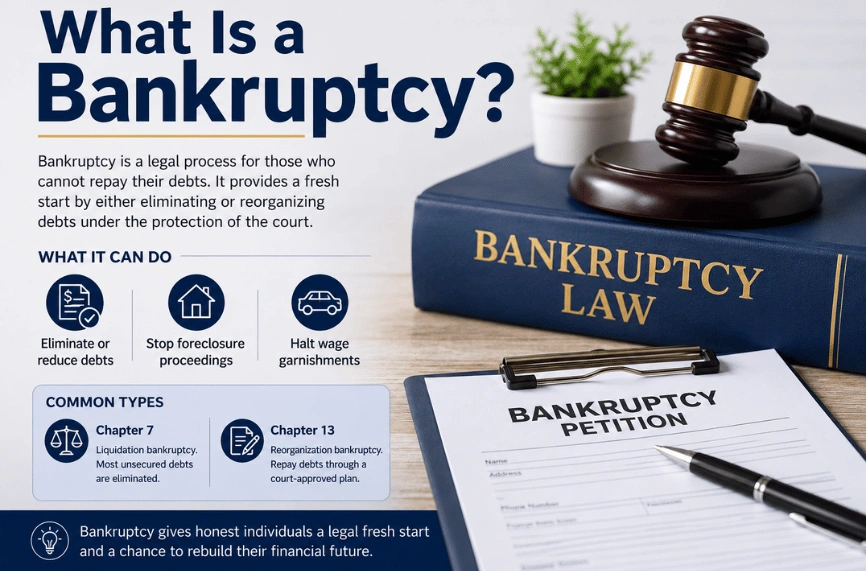
So what is bankruptcy once you strip the jargon out? It is a court-run reset for debt you cannot realistically repay, governed by federal law and supervised by a trustee. Below you get the three chapters compared, the property people actually keep, the debts that survive, the real cost in dollars, and the one step to take this week. Our guide to DIY Estate Planning covers this in more detail.
Chapter 7, Chapter 11, and Chapter 13 side by side
Picking a chapter comes down to three things: your income, your equity, and whether a business needs to keep trading. Here is the comparison that page one scatters across a dozen paragraphs. We cover this in more depth in What Does Et Al Mean? How to Use It Correctly in APA.
| Question | Chapter 7 | Chapter 11 | Chapter 13 |
| Who qualifies | Individuals and businesses. Individual filers above their state median income must pass the means test. | Any business, plus individuals with large or complex debts. Subchapter V is the streamlined small business track. | Individuals with steady income whose secured and unsecured debts fall under the statutory ceilings |
| What happens to your assets? | The trustee sells nonexempt property. Exemptions protect equity in a home, a car, and retirement accounts. | The company keeps trading and keeps its assets, operating under court supervision while it reorganizes. | You keep everything, including nonexempt items, and repay part of the value through the plan. |
| How long it takes | Roughly four to six months to discharge | Months to several years, depending on the plan and creditor votes | Three years below the state median income, five years above it |
| Court fees | $335 | About $1,700 | $310 |
| Best suited to | Lower-income filers with little equity and mostly credit card or medical debt | Companies worth more alive than liquidated, and high-debt individuals | Filers behind on a mortgage, protecting a car, or earning too much for Chapter 7 |
One nuance the chapter numbers hide: Chapter 13 is often the only realistic route for someone behind on a mortgage who wants to stay put. Mortgage arrears get cured across the life of the plan.
Key Takeaways
- Filing for bankruptcy pauses collection immediately. The automatic stay halts most calls, lawsuits, wage garnishment, and foreclosure while your case runs.
- Most consumer filers keep their property. Exemptions protect equity in a home, a vehicle, retirement savings, and household goods.
- No minimum debt amount exists. Nothing in the code sets a floor, so the test is whether current income can service what you owe.
- Court fees run about $335 for Chapter 7 and $310 for Chapter 13. Attorneys commonly charge $1,500 to $2,500 more for a straightforward Chapter 7 case.
- Some balances never disappear: child support, alimony, recent taxes, most student loans, criminal restitution, and drunk driving injury claims.
What is bankruptcy in plain terms?

A bankruptcy is a federal court process that pauses collection, then either erases qualifying debts or restructures them into a court-approved payment plan. You file a petition listing income, property, debts, and recent transfers. A trustee reviews it, creditors receive notice, and if the rules are met, the court issues a discharge order.
What Is Bankruptcy Relief? Arrives first. Once the clerk dockets your petition, the automatic stay stops most collection calls, garnishment, repossession, and foreclosure for the duration of the case. Creditors who ignore it can be sanctioned.
Courtroom drama barely features. Most filers attend one short session, the 341 meeting of creditors, which is an administrative interview run by the trustee rather than a trial before a judge. It frequently happens by phone or video, and it is often over in ten minutes. Creditors rarely turn up at all.
What happens to your house, your car, and your savings?

Start where the trustee starts, with the same arithmetic behind any net worth estimate you read about a public figure. Add up what you own, subtract what you owe against it, and what remains is equity. Equity is the only thing a trustee can convert into cash for creditors.
Bankruptcy exemptions then carve out what stays yours. Every state publishes its own list, and several let you pick the federal set instead. Typical protection covers a slice of home equity, one vehicle up to a value cap, tools of your trade, household goods, and clothing. Retirement accounts usually stay shielded in full.
That is why most consumer Chapter 7 cases close with the trustee selling nothing whatsoever. Keeping secured property carries one condition, though. Stay current on the car loan or the mortgage, because the lender can still take its collateral once the stay lifts.
Which Debts Survive the Process?
Discharge is broad, not total. Federal law lists categories that ride straight through the case, and no judge can waive them because your budget is tight:
- Child support and alimony, in full
- Recent income taxes and older tax debt in some situations
- Most student loans, unless you win a separate undue hardship ruling
- Criminal fines and restitution
- Debts for willful injury to a person or to property
- Claims from injuring someone while driving drunk
Secured debt sits in its own category. Courts can erase your personal obligation to pay while the lien on the property survives, which is why the car goes back if you stop paying for it.
What Filing Actually Costs

Page one is oddly quiet about money, so here are the numbers. The federal courts publish their own fee schedule: Chapter 7 charges $245 to file, a $75 administrative fee and a $15 trustee surcharge, totaling $335. Chapter 13 charges $235 plus the same $75 fee, so $310.
Two escape valves exist for people who cannot find even that. Filers earning below 150 percent of the federal poverty line can ask the court to waive the Chapter 7 fee outright. Anyone else can request to pay in as many as four installments, with the final payment due within 120 days of filing.
Legal help is the bigger line item. Straightforward Chapter 7 cases commonly run $1,500 to $2,500 in attorney fees, and Chapter 13 costs more because someone has to administer a plan for years. Add $10 to $50 for the mandatory counseling course. Every figure here comes from published court schedules and current fee surveys, and you can read about the team that publishes Notepare if you want to know who compiled them.
How long it takes and how long it follows you
Chapter 7 moves fastest. The court normally enters the discharge order 60 to 90 days after the date first set for the creditors meeting. Most cases therefore close four to six months after the petition. Chapter 13 ends only when the final plan payment clears, three to five years later.
Your credit file outlasts the case itself. Credit bureaus report a Chapter 7 bankruptcy for ten years from the filing date and a Chapter 13 for seven. Scores often begin recovering well before those clocks run out, because the reporting window and the rebuilding window are different things entirely.
What to Rule Out Before You File

Bankruptcy is not the only tool, and the counseling session the court requires will walk you through this ground anyway. Price these three options first:
- Direct negotiation with each creditor, which works best on unsecured balances a lender has already written down internally.
- A debt management plan through a nonprofit counseling agency, which reschedules payments without opening a court case.
- For-profit settlement companies, which charge fees, damage credit, and can leave you owing tax on forgiven balances.
Waiting can also be rational if your income is protected from garnishment and you own very little. Test that assumption with an attorney rather than a forum post, because state rules vary widely.
Your Next Step
What is a bankruptcy? Build one page before you talk to anybody: every balance you owe, who holds it, and your take-home pay for the past six months. That page decides which chapter fits, and no bankruptcy attorney can advise you without it. Book a free consultation next, since exemptions are state-specific and a wrong assumption there costs real money.
Frequently Asked Questions
The court supervised debt relief. You disclose your finances in full, a trustee checks the paperwork, and the court either cancels qualifying balances or approves a plan to repay part of them.
No minimum debt amount appears anywhere in the code. What matters is whether your current income can service your obligations, not whether you clear some dollar threshold.
No. Exemptions protect a defined list of property, retirement accounts usually escape untouched, and most consumer cases involve no asset sale at all.
Yes, subject to waiting periods. Eight years must pass between two Chapter 7 discharges, and shorter windows apply to the other combinations of chapters.
Court records are public, so the case is searchable in theory. In practice, creditors get formal notice, while neighbors and employers rarely go looking.