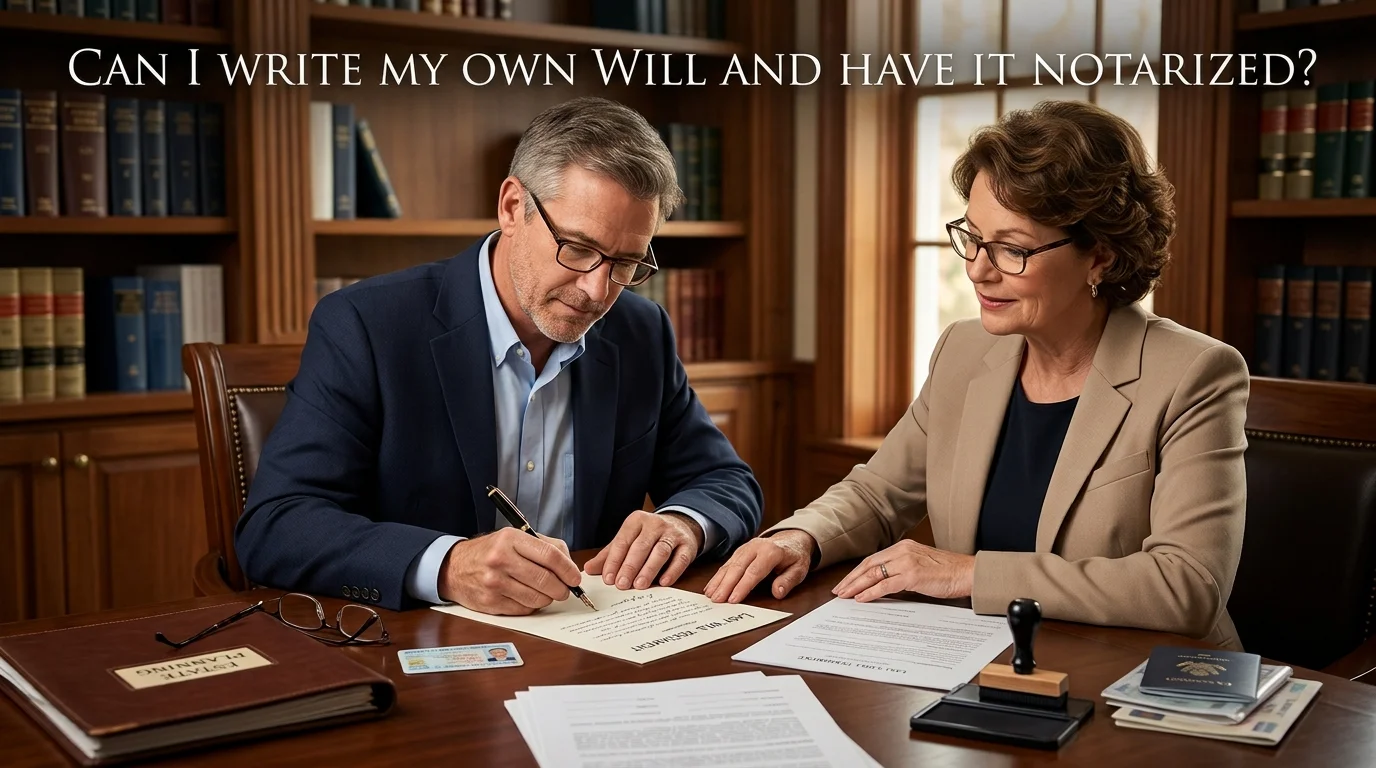
If you’re asking, “Can I write my own will and have it notarized?” the answer is often yes. However, a notary stamp does not replace your state’s signing requirements. A homemade document can fail if required witnesses, signatures, or other formalities are missing.
Short answer: Yes. You can usually prepare your own estate document in the United States, but notarization alone does not automatically make it valid. State law controls the signing process. Depending on where you live, you may need witnesses, a notary, both, or a special handwritten form. Check current state law before signing.
| Key question | What to know |
| Can you prepare the document yourself? | Often yes, if you follow your state’s requirements |
| Does notarization alone make it valid? | No; execution requirements still apply |
| Are witnesses required? | Commonly, but the exact rules vary by state |
| What is a self-proving affidavit? | A separate sworn statement that can help prove proper execution |
| Can a handwritten document work? | Some states recognize handwritten forms under special rules |
| Can you use online notarization? | Only when applicable state law permits it |
| When is a lawyer worth considering? | When you have a complex family situation, business interests, trusts, multi-state property, or a likely dispute |
Key Takeaways
- A notary verifies an acknowledgment, oath, or identity. That is different from determining whether an estate document is legally valid.
- Witness requirements matter in many states, even when notarization is available.
- A self-proving affidavit may make probate easier, but it does not repair improper execution.
- Handwritten estate documents receive different treatment from state to state.
- Check the current law where you live before the signing ceremony.
For more plain-language legal content, Notepare’s Law section is the closest internal resource for this topic.
Can I Write My Own Will and Have It Notarized Under State Law?
You can prepare your own document in many situations. However, there is no single national signing rule. State probate statutes determine what makes the document legally effective. That distinction matters because notarization has different roles across the country. Florida, California, New York, and Louisiana illustrate how significantly execution requirements can differ.
| State | Example of a signing requirement |
| California | A standard written document generally requires two witnesses. California also recognizes certain handwritten documents without witnesses when the signature and material provisions are in the writer’s handwriting. |
| Florida | The person signing must sign the document, or acknowledge the signature, before at least two attesting witnesses. The witnesses must also sign in accordance with statutory presence requirements. |
| New York | The ordinary execution procedure requires a written document, proper signing or acknowledgment, publication to witnesses, and at least two attesting witnesses. |
| Louisiana | Louisiana recognizes an entirely handwritten, dated, and signed form under Article 1575. Its notarial form requires a notary and two witnesses under Article 1576. |
This comparison shows the problem with generic advice such as “write it, sign it, and get it notarized.” The correct signing procedure depends on the law governing your document. Louisiana is a useful example. Its handwritten option is exempt from any other form requirement under Article 1575. Its separate notarial option requires a notary and two witnesses.
What Notarization Does and Does Not Do
A notary’s involvement can provide evidence of identity, acknowledgment, or an oath. A notary is not there to decide whether your document distributes property correctly or meets every probate requirement. In Florida, for example, a properly executed document can be made self-proving. The statutory process uses the signer’s acknowledgment and witness affidavits before an authorized officer.
That self-proving procedure is separate from the basic execution requirements. Florida still requires the underlying document to comply with the state’s execution rules.
A self-proving affidavit can reduce the need to establish the witnesses’ signatures later during probate. It should not be treated as a substitute for a correct signing ceremony. For this reason, a simple notary stamp should not be viewed as a cure for missing witnesses or other execution defects.
How to Sign a DIY Estate Document More Safely

Writing the document is only one part of the process. The signing procedure deserves the same level of attention.
- Check your state’s current probate statute first. Look specifically for execution, witness, handwritten-document, self-proof, and electronic-signing provisions.
- Finish the document before the signing ceremony. Avoid leaving beneficiary names, property provisions, or signature sections blank for later completion.
- Choose appropriate witnesses. Use adults who meet your state’s requirements. Choosing people who are not beneficiaries can also reduce avoidable questions or conflicts.
- Follow the required presence rules. Some statutes specify who must witness a signature or acknowledgment and when witnesses must sign.
- Complete a self-proving affidavit when your state permits one. Follow the statutory form rather than assuming that any generic notarized statement will work.
- Store the signed original safely. Your chosen executor or another trusted person should know where to find it when needed.
- Review the plan after major life changes. Marriage, divorce, births, deaths, significant property changes, and moves between states can justify another legal review.
Florida shows why these details matter. Its statute specifies both the signer’s interaction with two witnesses and how those witnesses must sign.
What Your Estate Document Should Address
A basic plan should clearly identify you and explain who receives your property after your death. It should also name the person responsible for administering your estate.
Common sections address:
- the executor and an alternate;
- named beneficiaries;
- specific gifts;
- the remaining estate after specific gifts;
- guardians for minor children, when relevant;
- revocation of earlier documents;
- signature and witness provisions required by state law.
You should also review assets that transfer through beneficiary designations or other ownership arrangements. Those arrangements may operate separately from the instructions in your probate document. Legal and financial processes can overlap in estate planning, but they are not interchangeable. Notepare’s bankruptcy guide covers a separate form of court-supervised debt relief and can provide broader legal and financial background.
Are Handwritten Documents Valid?
Sometimes. The answer depends on your state. California law recognizes a handwritten form when the signature and material provisions are in the writer’s handwriting. Witnesses are not required for that particular form. Louisiana has its own handwritten form. It requires the document to be entirely written, dated, and signed in the writer’s handwriting.
Those examples do not create a nationwide rule. A handwritten document that works in one jurisdiction may fail in another. Printed forms with handwritten additions can also raise issues different from those raised by a document written entirely by hand. Check the law that applies in your state before relying on the handwritten route.
Can You Use an Online Notary?
Remote notarization is another area where broad national advice can cause problems. Florida’s self-proof procedure allows for either in-person notarization or online notarization. That permission exists within Florida’s own statutory framework.
Other states may treat electronic execution differently. New York’s expanded electronic provisions are scheduled to take effect on December 12, 2027, so they are not yet effective as of August 2026. Do not assume that a state’s general remote-notary law automatically authorizes every estate-planning document. Check the specific probate and electronic-signing provisions first.
When Writing It Yourself Becomes Risky
A straightforward estate with simple gifts may be easier to handle without professional drafting. More complicated circumstances increase the risk that unclear language or execution errors will cause problems.
Consider consulting an estate-planning attorney when you have:
- Children from different relationships;
- A spouse and children from a prior relationship;
- A beneficiary with special needs;
- A closely held business;
- Property in more than one state;
- A trust-based estate plan;
- Plans to disinherit a close family member;
- Substantial assets or possible tax issues;
- Concerns about mental capacity or undue influence;
Family conflict that makes a future contest likely. Professional guidance may also be useful when your circumstances involve substantial assets, businesses, trusts, remarriage, stepchildren, or property in multiple jurisdictions. Paying for targeted legal review does not necessarily mean handing the entire process to a lawyer. You may be able to prepare your information first and ask an attorney to review the plan and signing procedure.
Before You Sign
Preparing your own estate plan can save money, but the final signing ceremony is not the place to guess. Check your state’s current probate statute before anyone signs. Confirm the witness requirements, notarization rules, handwritten-document provisions, and any self-proof procedure that applies.
If your family or property situation is complicated, consider having a licensed estate-planning attorney review the document before execution. You can also browse Notepare’s broader Education section for related explanatory content as the site expands its legal resources.
Frequently Asked Questions
Yes. In many circumstances, you can prepare the document yourself and use a notary when state law permits it. The critical issue is whether you also follow your state’s witness, signature, and execution requirements. Notarization alone does not guarantee validity.
Possibly. Some states require attesting witnesses for the standard execution process even when notarization is available for self-proving. A notary does not automatically replace required witnesses.
A self-proving affidavit is a sworn statement used to provide evidence that the required execution formalities were followed. The precise requirements depend on state law.
It can be valid in states that recognize qualifying handwritten documents. However, the requirements differ among jurisdictions, so you should check the law that applies where you live.
Sometimes. Some states permit online notarization in certain estate-planning situations, while others impose different rules or effective dates for electronic documents.
Improper execution can create problems when the document reaches probate. The outcome depends on state law and the nature of the defect. Because these consequences often arise after the signer’s death, correcting the error later may not be possible.