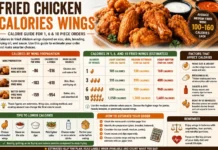
Wings are the one takeout order where the math surprises people. Ask three websites for fried chicken wing calories, and you get 103, 180, and 187, each one presented as a plain fact. None of those numbers are wrong. They are describing different wings, cooked different ways, and weighed on different scales. So the honest answer starts with a question back: what is on the wing, and how big is it? Once you know that, the number stops moving.
Fried Wing Calories by Preparation
| One wing, as prepared | Edible weight | Calories | Protein | Fat | Carbs |
| Meat only, skin and coating pulled off | about 0.8 oz | 40 to 55 | 5 to 7 g | 2 g | 0 g |
| Restaurant plain fried wing, no breading | not published | 72 | 8.8 g | 4 g | 0 g |
| Flour-dusted, flour-dusted, fried, skin-on | 1.1 oz | 103 | 8.4 g | 7.1 g | 0.8 g |
| Batter dipped, fried, skin on | 1.7 oz | 159 | 9.7 g | 10.7 g | 5.4 g |
| Fast food breaded wing | 2 oz with bone | 180 | 12.3 g | 11.7 g | 6.5 g |
Figures for the home-style and fast-food entries come from USDA FoodData Central reference data. Restaurant figures come from the current Buffalo Wild Wings nutrition guide, averaged per piece.
Key Takeaways
- One fried wing sits between 40 and 180 calories, and the coating decides where.
- Roughly 47 percent of a raw wing is bone, so per-wing figures that include bone read lower than they feel.
- Fried wing meat and skin run about 321 calories per 100 grams, or 32 calories for every extra 10 grams of edible weight.
- Sauce adds few calories but a large amount of sodium.
- Boneless wings are lighter in calories and much heavier in salt.
Why one wing can be 103 or 180 calories

Three things move the number, and they compound. The first is the coating. A light flour dusting adds under a gram of carbs and soaks up modest oil. A wet batter adds five times the carbs and holds far more frying fat, which is why the batter-dipped wing lands 56 calories above the flour-dusted one.
The second is weight, and this is where most articles quietly mislead. A flour-dusted wing is listed at 2.1 ounces whole, but bone accounts for about 47 percent of that. You eat 1.1 ounces. When a page reports 187 calories for a “medium wing,” it is scaling from a heavier bird, not describing a different recipe.
The third is oil uptake, which nobody weighs at home. Fried Chicken Wing Calories Deep frying at a low temperature or in tired oil pushes absorption up. That is the practical reason two batches from the same bag of wings can differ by 15 or 20 calories each.
Here is the rule that makes all of this portable. Fried wing meat and skin averages about 321 calories per 100 grams, so every extra 10 grams of edible meat on a wing adds close to 32 calories. Weigh your cooked wings once, and you never need a database again.
Fried chicken wing calories in a 2026 restaurant order
Restaurant portions are where the daily total actually gets decided. The Buffalo Wild Wings nutrition guide covering May 20, 2026, through August 18, 2026, gives clean per-order numbers for traditional bone-in wings.
| Traditional wings, plain | Calories | Protein | Fat | Sodium |
| 6-piece | 430 | 53 g | 24 g | 160 mg |
| 10-piece | 720 | 88 g | 41 g | 270 mg |
| 20-piece | 1,440 | 177 g | 82 g | 530 mg |
Work that back, and each unsauced restaurant wing averages 72 calories, well under the 103 figure most calorie apps return. Their wings are smaller than the USDA reference bird, and they skip the flour. Protein is the standout: a 10-piece order delivers 88 grams before you touch a side.
Takeout is rarely a one-off, and portions creep. If weeknight ordering is a habit in your house, the lifestyle section on Notepare covers more of these everyday eating questions.
Drumette or Flat: Which Piece Carries More

A wing arrives as two pieces plus a tip. The drumette is the meatier one, shaped like a small drumstick with a single bone. Flats carry two thin bones, less muscle, and proportionally more skin.
Skip the guesswork and use weight. Drumettes come off the scale heavier than flats from the same bird. At about 321 calories per 100 grams of edible wing, a drumette that outweighs a flat by 15 grams carries roughly 48 calories more. Flats feel richer because the skin-to-meat ratio is higher, but the piece is still smaller. If you are eating a mixed tray, assume the split evens out. If you pick out drumettes, add about 20 percent to your estimate.
What sauce adds, and why sodium matters more
Sauce barely registers on calories. Tossing a 10-piece order in Buffalo Medium takes it from 720 to 750 calories, an increase of three calories per wing. Honey BBQ is sweeter and pushes the same order to 820.
Sodium is the real story. Plain wings are almost salt-free at 270 milligrams for 10 pieces. Add Buffalo Medium, and that jumps to 1,900 milligrams. According to the Food and Drug Administration, the daily value for sodium is less than 2,300 milligrams a day. One sauced 10-piece order uses about 83 percent of that in a single sitting.
Dry rubs sidestep most of that. So does asking for sauce on the side and dipping, which typically transfers a fraction of what tossing applies. Anyone watching blood pressure should treat the sauce, not the frying, as the item to manage. For more on that side of things, our health articles go into everyday sodium sources in more detail.
Boneless wings are not the lighter pick

They look like the sensible order. On calories alone, they are: 6 boneless pieces come in at 360 against 430 for 6 traditional wings.
Then check the salt.
| 6-piece, plain | Calories | Protein | Sodium |
| Traditional, bone-in | 430 | 53 g | 160 mg |
| Boneless | 360 | 29 g | 1,260 mg |
Wings are breaded breast pieces, and the breading is seasoned before it ever meets sauce. Six of them carry nearly eight times the sodium of six real wings and 24 grams less protein. A 10-piece boneless order tossed in Buffalo Medium reaches 4,220 milligrams of sodium, which is close to double the entire Daily Value.
How Many Wings Fit Your Day
Most people want one thing from a calorie page: permission or a number to stop at. Here is the arithmetic for common daily targets, using the 103-calorie home fried wing and the 72-calorie restaurant wing.
| Calories you have spare | Home fried wings (103 each) | Restaurant plain wings (72 each) |
| 300 | 2 to 3 | 4 |
| 500 | 4 to 5 | 6 to 7 |
| 700 | 6 to 7 | 9 to 10 |
| 1,000 | 9 to 10 | 13 home-fried totals ignore ranch, celery, and fries, which is exactly where wing nights go sideways. Two ounces of blue cheese dressing can outweigh three wings on its own. Pair the numbers above with whatever activity you already do. The fitness guides on the site are a reasonable next stop if you want to plan a wing night around a training day. |
Those totals ignore ranch, celery, and fries, which is exactly where wing nights go sideways. Two ounces of blue cheese dressing can outweigh three wings on its own. Pair the numbers above with whatever activity you already do. The fitness guides on the site are a reasonable next stop if you want to plan a wing night around a training day.
Five ways to cut the calories without giving up wings

- Drop the batter. Switching from batter-dipped to a light flour dusting saves 56 calories a wing, the single biggest lever on this page.
- Bake or air fry. Both methods skip immersion in oil, and databases put the result nearer 85 to 90 calories a wing rather than 103.
- Remove the skin after cooking. Fry with it on for texture, then pull it off. That drops a wing to roughly 40 to 55 calories.
- Dip instead of toss. You control both the sauce volume and the sodium.
- Count before you order. A 10-piece plain order plus a dry rub keeps you near 750 calories with 88 grams of protein.
Ready to put a number on your own wing night? Weigh six cooked wings in grams, multiply the total by 3.21, and you will have a figure that beats any generic database entry. Save that number, because your wings will be roughly that size every time.
Conclusion
Fried Chicken Wing Calories can range from 103 to 180 calories per wing, depending on their size, coating, cooking method, and sauce. A lightly floured wing is a lower-calorie choice than a heavily battered or fast-food breaded wing, while plain restaurant wings often contain fewer calories because they skip the breading altogether.
Although wings are naturally high in protein, sauces and dressings can dramatically increase sodium and. In contrast,l calorie intake. If you’re trying to enjoy wings while managing your diet, choose plain or dry-rubbed wings, watch your portion size, and skip heavy dips. Understanding these differences makes it much easier to enjoy fried chicken without losing track of your daily nutrition goals.
Frequently Asked Questions
At home, 10 flour-dusted fried wings come to about 1,030 calories. A restaurant 10-piece of plain traditional wings is 720, and 750 once it is tossed in buffalo sauce.
Because each site is weighing a different thing: some quote the edible portion, some include the bone, and some use a fast-food wing with breading. Check the gram weight beside the number before you trust it.
Between 8 and 12 grams of protein, depending on size and coating. Ten wings land in the 85 to 120 gram range, which is a large share of most daily protein targets.
They can be. Wings are high in protein and contain almost no carbs when they are not battered, so the issue is portion size rather than the food itself. Six wings with a dry rub fit many plans. Twenty with dressing does not.
Yes, modestly. Without oil immersion, a wing absorbs less fat, and the usual saving is 10 to 15 calories per piece. The bigger win is that you can season heavily without needing a sauce.
Plain wings are low, at 270 milligrams for 10 pieces. Sauce changes that completely, taking the same order to 1,900 milligrams. Boneless versions start high before any sauce is added.