People searching William Afton real life usually want one clear answer: was the Five Nights at Freddy’s villain real? No credible evidence shows that he was a real murderer or historical figure. He is a fictional character from Scott Cawthon’s Five Nights at Freddy’s franchise.
The confusion makes sense because FNaF mixes crime, missing children, old restaurants, and unsettling animatronics. Those elements can resemble real events. Yet similarity doesn’t prove a real person behind the character.
| Key question | Answer |
|---|---|
| Is William Afton a real person? | No verified evidence shows that he is real. |
| Who created the FNaF franchise? | Game developer Scott Cawthon. |
| What role does Afton have? | He is a central villain tied to murders within FNaF fiction. |
| Is Freddy Fazbear’s Pizza real? | It is a fictional restaurant brand within the franchise. |
| Who plays Afton in the movies? | Matthew Lillard. |
| Is FNaF based on one true murder case? | No confirmed official source establishes that claim. |
Direct answer: William Afton is not a documented real-life serial killer. He is a fictional character from the Five Nights at Freddy’s story created by Scott Cawthon. Real restaurants and animatronic entertainment may remind players of FNaF, but no verified evidence connects Afton to one historical murderer or crime case.
Is William Afton Real Life or a Fictional Character?
The simplest answer is that Afton is fictional. He exists inside the games, books, and movie adaptations connected with Five Nights at Freddy’s. Searches for a police record or verified biography do not produce credible evidence that matches the fictional storyline.
The original Five Nights at Freddy’s game lists Scott Cawthon as its developer and publisher. The game places players inside the fictional Freddy Fazbear’s Pizza. Its hostile animatronics and mysterious backstory helped create the franchise’s horror mythology.
Later entries expanded the story surrounding the murders and the mysterious Purple Guy. Fans connected clues across minigames, dialogue, books, and later releases. That puzzle-like storytelling helped make the villain seem unusually detailed and believable.
Why Do People Think Afton Was a Real Person?
One reason is the franchise’s storytelling style. FNaF often reveals information through hidden details instead of straightforward explanations. As a result, players spend considerable time comparing clues and building theories.
Another reason involves real animatronic restaurants. American family entertainment venues have used robotic performers for decades. That familiar setting gives Freddy Fazbear’s Pizza a recognizable foundation, even though the restaurant is fictional.
Online theory culture adds another layer. Videos, posts, fan fiction, and short-form clips sometimes present speculation beside confirmed lore. Over time, viewers can lose track of which details came from official material.
Search results also include articles that link FNaF to unrelated crimes. These comparisons may sound persuasive because they share broad elements. Shared details alone do not prove that a fictional character represents a particular criminal.
Was Five Nights at Freddy’s Based on a True Story?
No confirmed evidence suggests the franchise retells a real murder case. The series uses fictional restaurants, fictional crimes, supernatural events, and invented characters. Official descriptions consistently present it as a horror game franchise rather than a dramatized true-crime story.
The original game describes a night security job at Freddy Fazbear’s Pizza. Its central threat comes from animatronic characters roaming after closing time. That setup appears clearly in the game’s official description.
Fans have compared the games with several American crimes. Treat those comparisons as theories unless Scott Cawthon or another authoritative source confirms them. A resemblance discovered after release is not the same as documented inspiration.
The safer distinction is simple. FNaF can use fears that feel familiar in the real world. Its specific murder mythology remains part of a fictional universe.
What Inspired the Character?
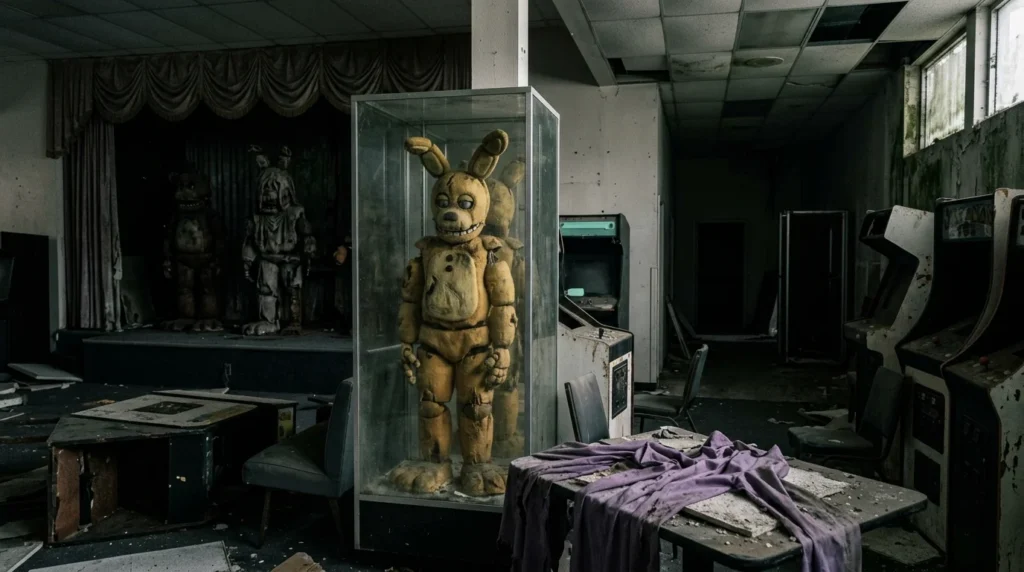
No authoritative source identifies a single real serial killer as the character’s direct model. Afton instead fits a recognizable horror role. He presents an ordinary public face while hiding violent behavior within the fictional story.
That approach works especially well inside a family restaurant setting. Bright mascots and birthday-party imagery contrast with the darker events beneath the surface. The contrast gives the series much of its unsettling tone.
FNaF also developed its antagonist gradually. Early games gave players fragments rather than a full conventional biography. That incomplete presentation encouraged years of theories about identity, motives, family connections, and chronology.
Readers interested in similar fictional-character breakdowns can explore Notepare’s Gaming section. Its Baldur character explainer shows how another major game antagonist fits his story. Broader movie and character coverage also appears in Notepare’s Entertainment section.
The Purple Guy, Springtrap, and Afton Explained
The Purple Guy became one of the franchise’s most recognizable mystery figures. Early minigames used simple purple imagery for the murderer. Fans later connected that figure with the named character developed across later FNaF material.
Springtrap represents another major part of that identity. Within the fictional chronology, the character becomes associated with a damaged springlock rabbit suit. This transformation helped turn a human villain into one of the series’ signature monsters.
The games have several timelines and interpretations, so fans often disagree on details. Books and movies also do not always follow the game continuity exactly. Separating each continuity prevents theories from being mistaken for universal canon.
That distinction matters for real-world searches too. A fictional death date or occupation in a fan database isn’t a historical record. It describes a character inside a particular interpretation of FNaF.
Who Plays William Afton in the FNaF Movies?
Matthew Lillard portrays the character in the film series. Peacock’s official cast material identifies Lillard in the role. Universal also lists him among the returning cast for Five Nights at Freddy’s 2.
The film version changes and reorganizes parts of the game mythology. That is normal for an adaptation. A movie can preserve central characters while changing relationships, chronology, and individual events.
Lillard’s performance also explains some searches for a “real” version of the villain. Viewers may encounter photographs showing a real actor dressed as the fictional character. The person in those images is the performer, not a real criminal named Afton.
Universal’s official movie material describes the film as based on Scott Cawthon’s game series. That wording clearly separates the fictional character from his actor. It does not present the story as a true-crime adaptation.
Is Freddy Fazbear’s Pizza a Real Restaurant?
Freddy Fazbear’s Pizza is a fictional business within the franchise. The original game presents it as a family restaurant featuring animatronic entertainment. Its design feels familiar because real American entertainment restaurants have used similar concepts.
That resemblance has produced countless rumors about abandoned locations and supposed crime scenes. Photos of unrelated restaurants can also be relabeled online. A recognizable building or animatronic does not establish a connection with FNaF lore.
Official promotions and themed experiences can use the Freddy Fazbear branding. Those events still represent a fictional entertainment property. They do not make the story’s restaurant chain historically real.
This distinction helps when checking viral claims. Look for an official source, original news report, or verifiable historical record. Avoid treating an unsourced social post as evidence.
Why the Real-Life Rumor Keeps Spreading
FNaF was built around uncertainty and discovery. Players often need to interpret brief scenes, newspaper clippings, sounds, and environmental clues. That structure naturally rewards speculation.
The franchise also reached audiences through YouTube theories and online communities. A theory can move from one creator to thousands of viewers within hours. Repetition sometimes makes an unsupported idea feel established.
Generative images and edited photographs make verification harder today. A convincing image can depict a fictional location or an invented historical figure. Visual realism alone should never be treated as proof.
A useful test is to ask whether the claim has a traceable primary source. Official game material can establish fictional canon. Reliable historical records are needed to establish a real person.
What Is Confirmed and What Is Fan Theory?
Several basic facts are easy to separate from speculation. Scott Cawthon developed the original game, and Freddy Fazbear’s Pizza is part of its fictional premise. Matthew Lillard portrays the movie antagonist.
Claims about a specific real murderer inspiring the character require stronger evidence. The same goes for supposed real addresses, police files, family photographs, and grave locations. Without reliable sourcing, those claims belong in the rumor category.
Fan theories still have value as entertainment. They let players examine clues and compare interpretations. Problems arise only when a theory is presented as documented real-world history.
The best approach is to clearly label each type of information. Canon describes officially established fictional events. Theory interprets the fiction, while historical fact requires independent real-world evidence.
Frequently Asked Questions About William Afton Real Life
Is there a real person named William Afton?
People can share almost any name, so someone somewhere may have that name. That does not make them the FNaF character. No verified person matches the fictional murderer’s complete story.
Was Afton based on a real serial killer?
No confirmed source identifies one serial killer as his direct basis. Online comparisons usually rely on similarities rather than documented statements. They should therefore be treated as speculation.
Is the Afton family real?
The family connected to the villain is part of FNaF fiction. Different franchise continuities also handle family relationships differently. Online claims about a matching historical family lack reliable supporting evidence.
Who is the real-life actor behind Afton?
Matthew Lillard portrays him in the live-action movie series. Lillard plays a fictional antagonist. Photos from the films should not be mistaken for evidence of a real murderer.
Did murders happen at a real Freddy Fazbear’s Pizza?
No verified restaurant crime establishes the fictional story as a true event. Freddy Fazbear’s Pizza is part of the franchise. Real crimes at unrelated restaurants should not be merged with its lore.
Is Springtrap real?
Springtrap is a fictional horror character connected with the franchise’s springlock-suit mythology. Physical costumes and promotional props can exist in reality. The supernatural character and his fictional history do not.
The Bottom Line
The evidence points to one clear conclusion: the FNaF antagonist is fictional. No reliable source establishes him as a historical murderer, restaurant owner, or hidden true-crime figure. Claims saying otherwise need evidence beyond fan theories, edited images, or coincidental similarities.
The stronger story is how successfully FNaF makes invented lore feel discoverable. Its clues encourage players to investigate every detail. That design keeps the real-life question alive even though the character remains fictional.
For more gaming character explanations, browse the Notepare gaming and entertainment sections. They cover movie and pop-culture topics. Checking those sections is the easiest next step for related explainers.