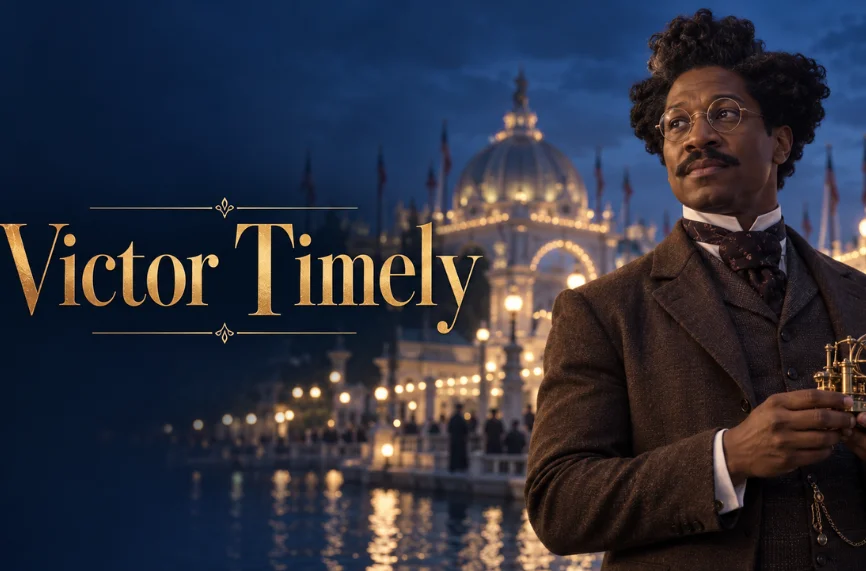
Victor Timely is one of Marvel’s most unusual versions of Kang the Conqueror. MCU viewers meet him as a nineteenth-century inventor with ambitious ideas about time. His story becomes central to Loki Season 2 and the TVA’s fate. He looks far less threatening than many Kang variants introduced across Marvel stories.
However, Victor Timely carries connections to He Who Remains, the Temporal Loom, and Marvel Comics history. Those connections explain why Loki immediately sees him as more than an eccentric inventor.
Direct answer: Victor Timely is a Kang-related character whose MCU version appears as an inventor living during the 1800s. In Loki Season 2, TVA knowledge changes his path and connects him to the Temporal Loom. His comic counterpart is considerably more calculating and builds an industrial empire in Wisconsin.
Quick Facts
| Fact | Details |
|---|---|
| Character | Kang-related inventor and temporal figure |
| Marvel Comics debut | Avengers Annual #21 in 1992 |
| Comic setting | Timely, Wisconsin |
| Comic role | Inventor, industrialist, mayor, Kang identity |
| MCU setting | Primarily 1893 |
| Major MCU appearance | Loki Season 2 |
| Earlier MCU tease | Ant-Man and the Wasp: Quantumania |
| Key MCU connection | Temporal Loom and TVA |
| Comic company | Timely Industries |
| Comic connection | Phineas Horton and the original Human Torch |
Marvel’s official character history places the comic identity in Wisconsin during 1901. The future conqueror establishes a town, becomes mayor, and builds Timely Industries. He then introduces advanced ideas decades before society should possess them.
Key Takeaways
- The MCU version is not simply the comic story copied onto television.
- His Loki storyline centers on whether outside knowledge shapes his destiny.
- The comic version deliberately uses history to strengthen Kang’s future position.
- Timely Industries becomes an important part of his long-term comic strategy.
- The MCU connects him closely with Ouroboros, the TVA handbook, and the Temporal Loom.
- His final Loki scenes suggest that destiny can change when crucial information disappears.
Who Is Victor Timely in the MCU?
The MCU introduces this inventor through the ending of Ant-Man and the Wasp: Quantumania. Loki and Mobius watch him demonstrate ideas about manipulating time before an audience. That footage later connects directly with events shown during Loki Season 2. Season 2 presents him as intelligent, ambitious, awkward, and capable of deceiving customers. He develops technology that resembles concepts used by the Time Variance Authority.
Yet he does not initially understand the immense conflict surrounding his existence. That distinction matters because the television version is not introduced as an established cosmic conqueror. He is still developing his ideas and identity when other characters find him. The series therefore asks whether dangerous people are born that way or shaped by circumstances.
Readers who enjoy character-focused entertainment coverage can also browse Notepare’s broader Entertainment section. The site also covers performers whose careers intersect with major American film and television franchises. One example is its Eric Lloyd career profile.
Why Victor Timely Matters in Loki Season 2
The TVA faces a crisis because its Temporal Loom cannot safely process expanding timeline branches. Access to its systems also depends on the temporal aura associated with He Who Remains. That makes the nineteenth-century inventor unexpectedly valuable to Loki and his allies. Loki and Mobius therefore try to bring him to the TVA. Ravonna Renslayer and Miss Minutes have different plans for him.
Sylvie initially sees eliminating him as a way to prevent another Kang-like threat. The competing objectives turn one relatively ordinary inventor into the center of the season’s conflict. Each group sees a different possibility inside the same man. That tension makes him more interesting than another straightforward multiverse villain.
The TVA Handbook Creates a Major Bootstrap Paradox
One of the season’s cleverest ideas involves the TVA handbook Ouroboros wrote. Ravonna gives a copy of that knowledge to the inventor while he is still young. He later uses its concepts while developing his own machines. The situation becomes stranger when he eventually meets Ouroboros at the TVA. O.B. recognizes ideas connected with his handbook inside the inventor’s work.
Meanwhile, the inventor has already built upon information originally created by O.B. This creates a classic bootstrap paradox. Knowledge appears to move in a circle without a simple original starting point. Loki uses that loop to reinforce its broader questions about free will and predetermined history.
How the Marvel Comics Version Is Different
The comic incarnation begins from a more deliberate and sinister position. Kang travels to 1901 and establishes the town of Timely, Wisconsin. He builds a technological base that can influence future decades without attracting immediate superhero attention. He also creates Timely Industries and introduces technology far ahead of its era.
Marvel’s official history describes the town becoming increasingly advanced under his direction. His long-term plan strengthens his resources while quietly shaping technological development. The comic character therefore functions less like a confused inventor caught in events. He is Kang using history as another weapon. His apparent normality allows him to operate without announcing his larger ambitions.
| Element | MCU version | Marvel Comics version |
|---|---|---|
| Era | Primarily 1893 | Establishes Timely in 1901 |
| Starting role | Inventor | Kang operating under another identity |
| Knowledge source | Influenced by TVA information | Knowledge comes from his future experience. |
| Main goal | Develop inventions and understand events. | Build power for future conquest. |
| Timely, Wisconsin | Has a laboratory connection | Founds the town |
| Timely Industries | Not central to the television story | Major part of his strategy |
| Moral presentation | Ambiguous and impressionable | Calculating and manipulative |
| Temporal importance | Helps address the Loom crisis | Builds infrastructure across history |
The differences prevent the MCU storyline from becoming a predictable adaptation. Comic readers know the name carries dangerous implications. Television viewers instead watch the character confront choices that might lead toward, or away from, that future.
Notepare readers interested in other long-form entertainment profiles can explore its Trey Parker career guide. The site also publishes detailed television and film biographies, including its Jeffrey Donovan profile.
Timely, Wisconsin and the Importance of Timely Industries
In Marvel Comics, Kang does more than hide in the past. He creates an entire community around his new identity. Timely, Wisconsin becomes a protected base where advanced technology can develop gradually. Timely Industries lets him seed future innovations while maintaining control. Marvel specifically connects his activities with robotics, computers, and later technological systems.
His work ultimately reaches far beyond one small Midwestern town. The location also houses connections to Chronopolis, Kang’s extraordinary base beyond ordinary time. This gives the peaceful-looking town a much larger strategic purpose. It is effectively a historical doorway into the conqueror’s wider empire.
His Connection to the Original Human Torch
The comics also connect this identity with Phineas Horton. Horton eventually creates the original android Human Torch, decades before Johnny Storm uses that superhero name. Kang’s historical influence helps explain how Horton develops unusually advanced technology for his period. This connection shows how carefully Marvel writers integrated the character into older comic history.
His presence allows futuristic knowledge to influence technological developments in earlier decades. That creates consequences extending beyond the immediate Kang story. The MCU has not reproduced that storyline directly. Its version instead focuses on the TVA, branching timelines, and the Temporal Loom. That choice keeps the television story tied closely to Loki rather than broader android history.
What Happens to Timely at the End of Loki Season 2?

The inventor initially appears to die while trying to repair the Temporal Loom. Loki’s growing control over time gives him repeated opportunities to revisit the crisis. Eventually, the inventor survives long enough to complete the planned adjustment. The repair still cannot solve the deeper mathematical problem. Infinite timeline branches cannot simply fit through a machine designed to manage limited growth. Loki eventually chooses another solution by personally sustaining the branching multiverse.
The final episode also returns to the inventor’s childhood. This time, the TVA handbook is not delivered to him. That small change suggests his future may develop differently without the knowledge that previously shaped him.
Is He a Villain?
Calling the MCU version a straightforward villain misses the point of his story. He cheats customers and shows selfish instincts, but he also helps the TVA during a dangerous crisis. His behavior differs sharply from the openly domineering versions of Kang. The series deliberately leaves room for environment and choice. Receiving advanced TVA knowledge influences what the young inventor becomes.
Removing that information at the end creates the possibility of another path. His comic counterpart offers far less ambiguity. There, the identity forms part of Kang’s deliberate attempt to influence history. The pleasant industrialist persona hides plans designed to strengthen his future power.
Why This Kang Variant Stands Out
Most major versions of Kang arrive with enormous technology or clear ambitions for domination. This one first appears behind a demonstration table in nineteenth-century clothing. That contrast makes the danger around him less obvious. His story also turns technological progress into a question about cause and effect. An inventor learns from a handbook produced by a future organization.
That organization then depends partly on ideas linked back to the same inventor. The comic version approaches the same theme from another direction. Kang deliberately plants future knowledge inside the past. Both stories therefore use technology to show how time travel can erase simple ideas about cause and origin.
Frequently Asked Questions About Victor Timely
Is Victor Timely the same person as Kang the Conqueror?
The answer depends on the continuity. In the comics, the name operates as an identity connected directly with Kang’s historical plans. The MCU treats the character as a variant whose path develops differently from other Kang-related figures.
What year does the MCU storyline take place?
The major World’s Fair sequence takes place in 1893. Loki and Mobius encounter the inventor while following activity connected with Ravonna and Miss Minutes. The season’s third episode is appropriately titled “1893.”
Did he create the TVA?
The series does not present him as the straightforward creator of the TVA. His inventions overlap with concepts used by the organization, partly because he receives its handbook. That circular exchange of knowledge is one of the season’s central time paradoxes.
Why does Loki fear him?
Loki has already encountered He Who Remains and understands the danger posed by his variants. He therefore recognizes the inventor’s appearance as a warning sign. Mobius initially sees someone far less intimidating than the figure Loki remembers.
Does the character survive?
The season briefly shows him dying during the Temporal Loom crisis. Later time manipulation changes those events, allowing him to survive that attempt. The ending then suggests his childhood takes a different direction without receiving the handbook.
What His Story Means for Marvel
The character works because Marvel uses him for more than another villain reveal. His MCU story asks whether access to powerful knowledge can create the future people fear. The final childhood scene suggests changing information can change a life. His comic history adds another layer for readers who know Kang’s larger mythology. The earlier version manipulates technology, industry, and generations from a hidden base.
The television adaptation turns those concepts into a more personal story about choice and causality. For viewers finishing Loki, understanding this character makes several confusing plot points easier to follow. It clarifies the handbook paradox, the Loom crisis, and Kang’s connection with nineteenth-century technology. It also explains why one unassuming inventor becomes so important to the TVA.