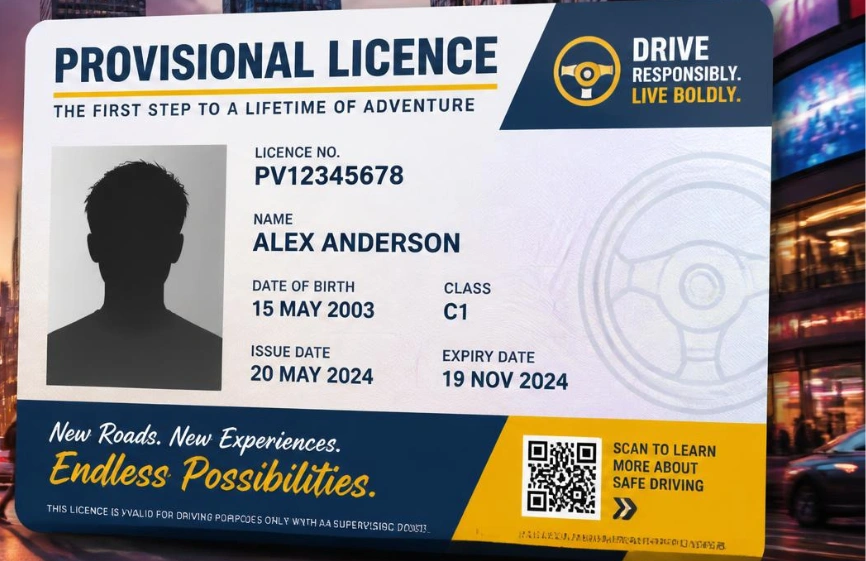
A provisional license is the restricted driving stage that usually comes after a learner’s permit and before a full driver’s license in U.S. graduated licensing systems. It typically lets a new driver operate a vehicle without a supervising adult, but limits may apply to nighttime driving, young passengers, phone use, and other higher-risk situations. Because driver licensing law is state-specific, the rules published by your state DMV or licensing agency always control.
| Key point | What it generally means in the U.S. |
| Licensing stage | Usually the intermediate stage between a learner permit and unrestricted driving |
| Driving alone | Often allowed, subject to state restrictions |
| Common restrictions | Night driving, young passengers, electronic devices, and alcohol |
| Eligibility | Usually depends on age, permit history, practice, education, and testing |
| Duration | Varies by state, age, driving record, and time licensed |
| Next stage | Full or unrestricted driver’s license |
Direct answer: An intermediate driver license lets a new driver begin unsupervised driving under state-set conditions. Common limits include late-night driving, young passengers, and phone use, but age thresholds, waiting periods, exceptions, and the time required before unrestricted driving differ by state, so you should verify the current rules with your licensing agency.
Key Takeaways
- U.S. states use graduated driver licensing to introduce driving privileges in stages.
- The intermediate stage often permits solo driving but does not provide unrestricted adult privileges.
- Nighttime and passenger limits are among the most common restrictions.
- The minimum age, required practice, holding period, and exceptions differ by state.
- Tickets, crashes, or violations can delay advancement or trigger additional penalties.
- Your state licensing agency is the final source for rules that apply to you.
What Does “Provisional” Mean on a Driver’s License?
Graduated driver licensing, often shortened to GDL, divides the learning process into stages so novice drivers gain experience gradually. NHTSA’s teen driving guidance describes the typical sequence as a learner stage, an intermediate or provisional stage, and full licensure. The middle stage introduces independent driving while limiting situations associated with greater risk for inexperienced drivers.
The terminology is not identical across the country, which is one reason the topic can be confusing. A state may use terms such as intermediate, restricted, probationary, junior, limited, or provisional for a similar point in its licensing process. The current IIHS state-by-state graduated licensing table shows substantial differences in entry ages, permit periods, supervised practice, night restrictions, and passenger limits.
Readers looking for broader vehicle information can also browse Notepare’s Automobile section. That section provides a useful home for related driving and vehicle ownership topics. It can also help new drivers build practical knowledge beyond the licensing process.
Provisional License vs. Learner’s Permit vs. Full License

The easiest way to understand the three stages is to compare how much independence each one provides. A provisional license learner permit normally requires supervision, while the intermediate stage commonly allows some independent driving. Full licensure removes the special novice-driver limits once the state’s requirements are satisfied.
| Feature | Learner permit | Intermediate/restricted stage | Full license |
| Drive without a supervisor. | Usually no | Often yes. | Yes. |
| Night driving limits | Supervision rules usually apply | Common | Standard traffic law applies. |
| Passenger limits | State-specific | Common for young drivers | Usually no special novice limit |
| Phone restrictions | Often stricter for minors | Often stricter for minors | General state law applies. |
| Purpose | Supervised practice | Lower-risk independent experience | Unrestricted driving privileges |
This distinction matters because passing a road test does not always remove every licensing restriction. A newly licensed teenager may be legally permitted to drive to school alone while still being barred from carrying several teenage friends or driving late at night. Checking the restrictions attached to the actual credential prevents assumptions based on what older friends or drivers in another state were allowed to do.
Common Restrictions for New Drivers in the U.S.
Nighttime restrictions are a central feature of many graduated licensing systems because new drivers face additional risk during unsupervised night driving. Passenger restrictions are also common because carrying young passengers can create distractions and increase risk for inexperienced drivers. Federal safety guidance also recommends strong limits on portable electronic devices during the intermediate stage.
Common restrictions can include:
- No unsupervised driving during specified nighttime hours.
- Limits on passengers below a certain age.
- Exceptions for immediate family members.
- Work, school, medical, or emergency exceptions.
- Restrictions on handheld or hands-free phone use.
- Zero-tolerance rules involving alcohol for underage drivers.
- A requirement to maintain a safe driving record before advancing.
The exact details can look quite different from one state to another. California, Texas, Maryland, and Oregon provide good examples because each permits independent driving while setting its own limits and exceptions. Their current agency guidance shows why a nationwide article should explain patterns without presenting one state’s rule as a national rule.
| State example | Selected current restrictions |
| California | Drivers under 18 face 11 p.m. to 5 a.m. and under-20 passenger restrictions during the first 12 months, subject to stated exceptions. |
| Texas | Drivers under 18 may not carry more than one non-family passenger under 21, face midnight to 5 a.m. limits, and cannot use cell phones except for emergencies. |
| Maryland | Drivers under 18 face passenger limits during the first 151 days, midnight to 5 a.m. restrictions, and wireless-device restrictions. |
| Oregon | Passenger limits change after the first six months, while midnight to 5 a.m. restrictions and mobile-device rules apply under specified conditions. |
The table is an illustration, not a substitute for your state handbook. Rules may change through legislation or agency updates, and exceptions can depend on the reason for a trip. Before driving under an exception, confirm whether your state requires documentation from a parent, school, employer, physician, or another authorized person.
How Do You Get an Intermediate Driver’s License?
There is no single national application process because states issue driver credentials. Still, many programs require a learner stage, supervised practice, driver education or training, and a driving test before independent privileges begin. Texas, Maryland, California, and other states combine these elements in different ways.
A typical path looks like this:
- Meet your state’s minimum age requirement.
- Obtain and hold a learner or instruction permit for the required period.
- Complete required driver education and supervised practice hours.
- Maintain the driving record required for advancement.
- Pass any required vision, knowledge, and behind-the-wheel tests.
- Submit identification, parental authorization, or other required documents.
- Follow intermediate-stage restrictions until you qualify for full privileges.
Requirements can vary even for applicants within the same state because age and education status may change the process. Maryland, for example, lists different learner-permit holding periods for certain age groups while still requiring other licensing steps. Texas requires teen applicants to complete its graduated licensing requirements before moving into independent driving.
If you are also preparing for your first vehicle, practical ownership questions become relevant at the same time. Notepare’s article about selling and choosing practical cars around graduation season discusses factors such as reliability, fuel economy, maintenance costs, and safety. Those considerations can be useful for a newly licensed driver or family choosing an affordable first car.
How Long Do Restrictions Last Before You Get a Full License?
There is no nationwide answer because states tie advancement to different combinations of age, time licensed, and driving history. California treats drivers under 18 as provisional during the first year, while Texas keeps its Phase II restrictions on qualifying drivers until their 18th birthday. Maryland requires a clean driving record for 18 months before moving from its intermediate stage to a full driver’s license.
Oregon provides another example of how restrictions can phase out over time. Its passenger rules change after the first six months, and passenger and night restrictions generally end when the driver turns 18 or has held the credential for one year, whichever comes first. These differences make your issue date, birthday, and driving record important when calculating when full privileges begin.
What Happens If You Break the Restrictions?
Breaking an intermediate-stage rule can have consequences beyond an ordinary traffic citation. Depending on the state and violation, a driver may face a suspension, additional education, an extended restricted period, or delayed eligibility for full licensing. Maryland, for example, publishes specific sanctions for passenger, nighttime, wireless-device, alcohol, and moving violations.
A violation can also affect the timeline even when the driver eventually regains valid driving privileges. Some state systems require a clean or violation-free period before advancement, which means a new offense can restart or extend that waiting period. The safest approach is to treat the restrictions printed in your state handbook as conditions of your driving privilege rather than optional recommendations.
For broader explanations of legal concepts and responsibilities, readers can browse Notepare’s Law section. That section covers legal topics written for general readers rather than practitioners. Driver licensing rules still need to be checked against your state’s official motor vehicle agency because those requirements can change.
Why Graduated Licensing Uses These Restrictions
New drivers need experience, but giving every privilege at once can expose them to difficult conditions before they have enough time behind the wheel. CDC research on teen drivers reports that graduated driver licensing systems extend practice and restrict higher-risk situations while novice drivers develop experience. Research summarized by the agency has associated GDL systems with reductions in injury and fatal crashes among 16-year-old drivers.
The restrictions therefore focus on circumstances that are harder for an inexperienced driver to manage. Night driving reduces visibility, young passengers can increase distraction, and phones compete for a driver’s attention. The intermediate period creates room to practice everyday driving before those additional demands are added.
Newly licensed drivers may also benefit from learning more about the vehicles they use. For example, Notepare’s Volvo C30 T5 vehicle guide shows the kinds of performance, safety, reliability, and maintenance details worth researching before driving or buying a used vehicle. Vehicle knowledge cannot replace driver training, but it can help a new owner understand the car they depend on.
What to Do Before Your Next Drive
Open the official licensing page for the state that issued your credential and write down your current curfew, passenger limit, device rule, exceptions, and expected upgrade date. Keep any documentation your state requires for work, school, medical, or family exceptions, and review the rules again before traveling under unusual circumstances. Knowing the conditions attached to your provisional license is the simplest way to avoid an accidental violation while you build the experience needed for full licensing.
Frequently Asked Questions
Can you drive alone with an intermediate driver’s license?
In many states, yes, because independent driving is the main difference between the learner stage and the intermediate stage. That freedom is usually subject to restrictions involving time of day, passengers, devices, or the purpose of a trip. Check the state that issued your credential before assuming you can drive alone in every situation.
Can I use a provisional license as a regular license?
It is a valid driver credential within the privileges granted by the issuing state, but it is not the same as unrestricted driving status. You must continue following every condition that applies to your age and licensing stage. Once you satisfy your state’s time, age, record, and other requirements, you can move toward full privileges.
Are the restrictions the same in every state?
No, and the differences can be substantial. States set their own ages, curfews, passenger limits, practice requirements, exceptions, and advancement rules. Current IIHS data provides a useful nationwide comparison, but your state motor vehicle agency remains the controlling source for your individual situation.
How long does the intermediate stage last?
The answer depends on the state rather than one federal timetable. Some restrictions expire after a fixed period, while others remain until a birthday or until the driver maintains a clean record for the required time. California, Texas, Maryland, and Oregon illustrate several different approaches to ending novice-driver restrictions.
Is an intermediate driver’s license the same as a learner permit?
No, although state terminology sometimes causes confusion. A learner permit generally requires a qualified supervising driver, while the next stage often allows independent driving under specific restrictions. Texas state guidance clearly distinguishes supervised learner driving from restricted independent driving in its graduated licensing program.
Can a traffic ticket delay a full driver’s license?
Yes, it can in states that require a clean driving period before advancement. A violation may also result in education requirements, suspension, or other sanctions depending on local law. Review your state’s rules after any citation instead of assuming your original upgrade date still applies.